
Paver Driveways
The first thing anyone sees, and the last thing most people fix.
Clay and concrete pavers laid over a compacted base that carries a vehicle.
What goes into one
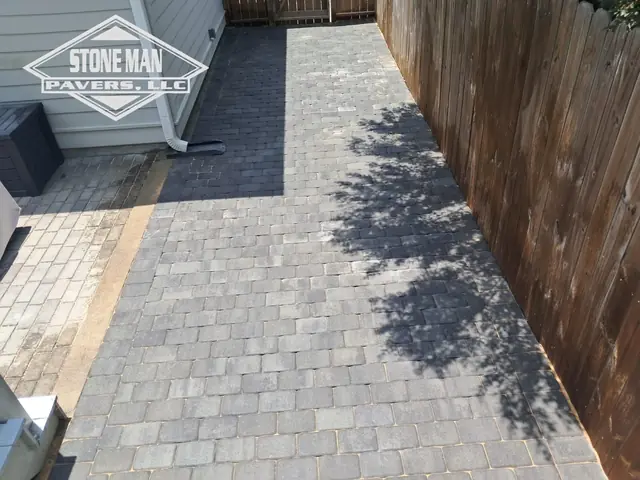
- Excavation to a depth set by the ground, not by a standard number
- Compacted aggregate base, built up in layers rather than in one lift
- A soldier-course border, edged so the field has something to push against
- Joint sand swept and settled once the field is laid
How the units are laid
Pick a pattern to see it drawn. On a driveway this is a structural choice before it is a visual one.
Every unit is locked by its neighbors in two directions, so a turning wheel cannot walk it out of line. It is the pattern their own front walk photographs are laid in, and it is the standard answer where vehicles are involved.
Walkways & Steps
A concrete ribbon is not a front entrance.
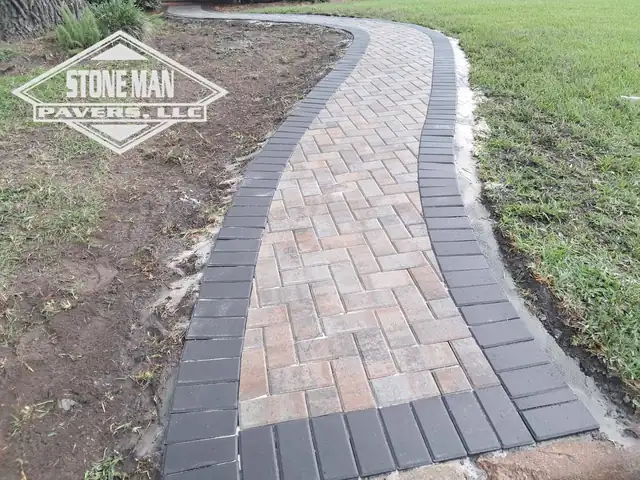
Curved walks, cut to the line the ground actually wants.
What goes into one
- The old walk broken out and carted, not paved over
- A curve set on the ground with a hose before anything is cut
- Herringbone field inside a contrasting soldier course
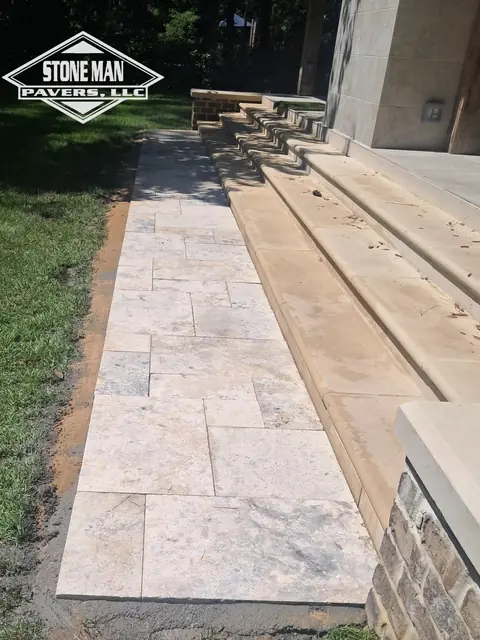
- Steps and landings tied into the same run where the grade needs them
How a front walk actually goes
Four days of work in the order it happens. Their own photographs of this job are on the home page.
- 01Break out and cartThe old concrete comes up in slabs and leaves the site. That is the pile you can see stacked on the lawn in the middle frame on the home page.
- 02Dig and compactThe trench goes deeper than the old slab sat, and the base is built back up in layers and compacted between each one.
- 03Set the curve and the borderThe soldier course goes down first and defines the shape. Everything after this is filled in against it, which is why the edge is what gets set carefully.
- 04Lay, cut and sandThe field is run into the border, cut to the curve, then compacted and the joints swept full.
Repairs & Releveling
Half a patio is not a reason to replace all of it.
Lifting, relaying and replacing units that have sunk, moved or broken.
What a repair visit covers
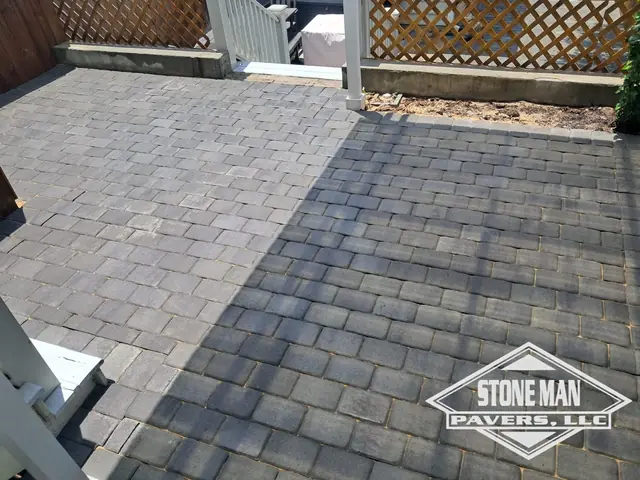
- Lifting the affected area rather than the whole field
- Finding what moved the base before putting anything back
- Relaying the original units where they are sound
- Matching replacements for the ones that are not
What is your surface doing?
Tick what you can see. Nothing here diagnoses anything: it decides what is worth looking at first on the visit.
Questions
Questions people actually ask.
Paver Driveways
Can pavers go over my existing concrete driveway?
Sometimes, and it depends entirely on the slab. If it is sound, drains the right way and there is height to spare at the garage door and the street, an overlay is possible. If it is cracked or moving, laying over it inherits the problem. That is a look-at-it answer, not a website answer.
What happens where the driveway meets the street?
The curb edge takes the most abuse on the whole job, because that is where wheels cross at an angle. It gets a restrained border rather than a cut edge left to fend for itself.
Will weeds come up through the joints?
Anything growing in a joint has germinated in the sand from above rather than pushed up from below. Keeping the joints full is what keeps that down, and it is a maintenance job rather than a one-time fix.
Walkways & Steps
Does the walk have to follow the old line?
No, and it usually should not. The old line was drawn to be cheap to form. A curve costs the same in pavers and is the main reason a new walk reads as designed rather than replaced.
What about the grass either side?
There will be a strip of bare soil along both edges when the work finishes, because the trench was wider than the walk. That is what the after photograph on the home page shows, and it grows back in.
Can steps be part of the same job?
Yes. Steps and landings are on their service list and appear in their photographs, run in the same units as the walk or faced in stone where the entrance calls for it.
Repairs & Releveling
Can you match my existing pavers?
Often, and it depends on the unit and how much sun it has had. Colors fade, so a brand new unit of the same product can sit lighter than its neighbors. Where a match matters, units are sometimes taken from a hidden area and the new ones put there instead.
Is it worth repairing or should I start again?
If the field is sound and one area has moved, repair. If the base was never right across the whole area, a repair moves the problem rather than fixing it. Which of those you have is visible on site and not from a photograph.
Do you repair work someone else laid?
The review describing this job was for an existing patio, so yes. What it costs and whether it is worth doing is a conversation on the property.
Driveways & Walks
The way in, and the way up to the door. Send photos of the space and someone will come and look at it.